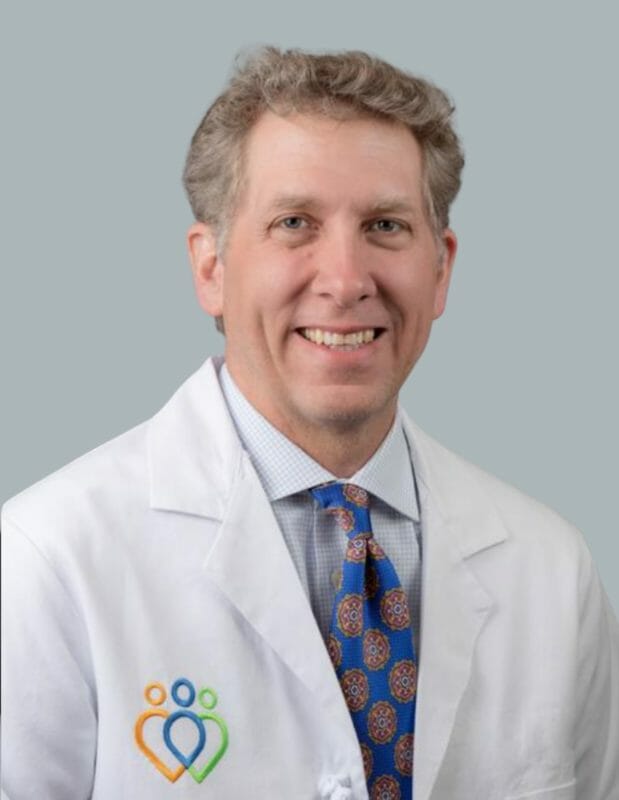
Dr. Todd Caulfield is the Past President of Staff for all the Westside Portland Cardiology clinics and the Clinical Chief of Cardiology for the Providence Heart Institute of Oregon. When asked about what leadership means to him, and how he views his role in overseeing countless highly skilled physicians, he replies:
“Leadership is service. I report to them.”
Dr. Caulfield is an interventional cardiologist by trade who attended medical school at George Washington University and Beth Israel Deaconess Medical Center for residency. He began his leadership experience by bringing interventional cardiology clinical trials to Providence Saint Vincent Hospital in Portland, at the time a 3rd tier community hospital with scarce research innovations.
“I love [medicine] because it has allowed me to pursue all my interests as a physician.” Though his institution had no research opportunities at the time, Dr. Caulfield had the passion and know-how to initiate research wherever he went. When he got to Portland, he wanted to bring the best cutting-edge medical practices to his patients, so he started running clinical research.
After conducting several smaller studies, Dr. Caulfield added catheter valve replacements to his research innovations. Replacing valves through catheters is an invaluable practice because it replaces the need for open-heart surgery in these cases. Utilizing only arterial and venous lines, this technique makes valve replacements a same day procedure, meaning patients could go home the same day they had a valve replaced, and had much smoother recovery times compared to the open-heart surgeries required before. Additionally, open heart surgery is often contraindicated in the most vulnerable patient populations because of the difficult recovery process from the surgery, though these were often the patients who needed the surgery the most.
The other reason this advancement was also special to Dr. Caulfield and his team was that clinical trials for this procedure were extremely rare. They were only offered to top tier, quaternary healthcare centers with research wings and fellowships. Providence Saint Vincent was, at the time, a small third tier community hospital and did not have research wings before Dr. Caulfield arrived. In fact, at that time, there were no other institutions in Oregon equipped to handle a clinical trial at this caliber. Despite there not being an institution in Oregon ready to open such a trial, Dr. Caulfield, driven by service to patients and a desire to provide them with the best care possible, said, “if I don’t do this, no one will.”
In fact, he knew he could not do it on his own. Even though he had successfully led several trials previously, he knew he needed to build an interdisciplinary team to advocate for and push new clinical trials, culminating in the catheter valve replacement trials. To this end, he assembled cardiologists, anesthesiologists, surgical techs, and nurses into an elite team that could run these trials and bring the best care to his patients. This was the most challenging part, and arguably the part that made it all possible.
The challenge here was working with diverse talents and specialists, coordinating care, and leading different personalities to develop quality care. He had to learn to mesh well with professionals that had differing expertise, various talents and communication styles. However, it was from this challenge that Dr. Caulfield then realized how much he loves building teams. Through this process he realized “I had something more I could offer to serve.”
Providence had one clinical trial before he arrived. Now, it is a full quaternary healthcare center with research and fellowships.
This was all driven by Dr. Caulfield’s guiding principle of “being authentic to yourself.” His passion was interventional cardiology, so that is what he practiced. In addition to his expertise and passion to serve patients with the highest quality care, he had a passion for starting clinical trials. Through his trials and the challenges in leading that team, he learned he had a passion for building teams and advocating. All of these realizations he says come from the need to have experience with yourself – what others might call maturity.
This experience and time spent learning about himself helped guide him to identify his own core values that drove his practice, his research, and grounded his leadership. And for him, his key core value is service. First and foremost, he has always been of service to his patients and improving healthcare delivery and outcomes, but now he adds service to his fellow cardiologists. He does not claim to be the boss of the over 100 cardiologists in Oregon with his authority, but rather views his role as an opportunity to serve them. He says these drivers and passions may change over 20 years of practice, but there is a demand for you to be authentic to yourself and the things you need to do to be true to yourself. Service, integrity, as well as being fully honest with himself, his family, and others are his three key drivers.
When asked about his leadership style, Dr. Caulfield says it has evolved over the years. He started by being a micromanaging type, being hands-on, and was often offended when he was not involved in the decision-making process. He admits now that this way actually hindered progress. He sees now that involving others and raising new physician leaders is part of distributive leadership, empowering others to make decisions and to lead, leading to a form of succession.
This essentially plays out in the restructuring of his cardiology clinics. In order to grow, he saw the need to completely restructure the way the clinics are set up, and all this change towards consistency and quality improvement can be difficult. He has found the best way to lead change is to empower individuals within his team, give autonomy back to the clinic leaders, and help them see how they are leading in their practices and clinics. Dr. Caulfield now views leadership as the active improving of others to be leaders in their sphere of influence.
When asked about what he enjoys most about his roles, he says the gratification of being a physician is the instant success you can see, and how in those moments where you provide quality care and change a patient’s life, you can start a great relationship. Leadership is almost the opposite. In the short term, there is often push back, critique, people always telling you that you are doing it wrong. He says you must learn to be comfortable with slow progress. It is easy to “lose the forest for the trees,” so in leadership roles, it is imperative to be patient and reflect over the past one year, five years, and potentially even more to see the changes and improvements you have been a part of.
Dr. Caulfield once thought leadership was about having vision and compelling others to follow your vision, but now he views leadership as being engaged with your team, allowing your team to share their dreams, and finding a way to make people feel represented, and that their dreams are a part of the direction of the organization. Part of this comes from recognizing you are not the smartest person in the room – you have to listen to others who know more than you.
Dr. Caulfield says you need to be happy to serve in whatever capacity you are qualified for. For young aspiring physician leaders, seek qualifications and seek to grow your skills. To continue developing himself as a physician, he has pursued several leadership certificates, and he always keeps up with his mentors. I love the fact that despite over two decades of medical practice and leading cardiology for Oregon, he knows he still needs to grow.
To young leaders, find a way to be involved in change, be willing to sit at the table and make decisions. Be a part of system development, train young leaders, and lean on your mentors.